
Great Cycling Flops Week 1: The Boneshaker — The Bike Craze That Lasted One Season
- Posted on
- By Blue Cycles Team
- 0
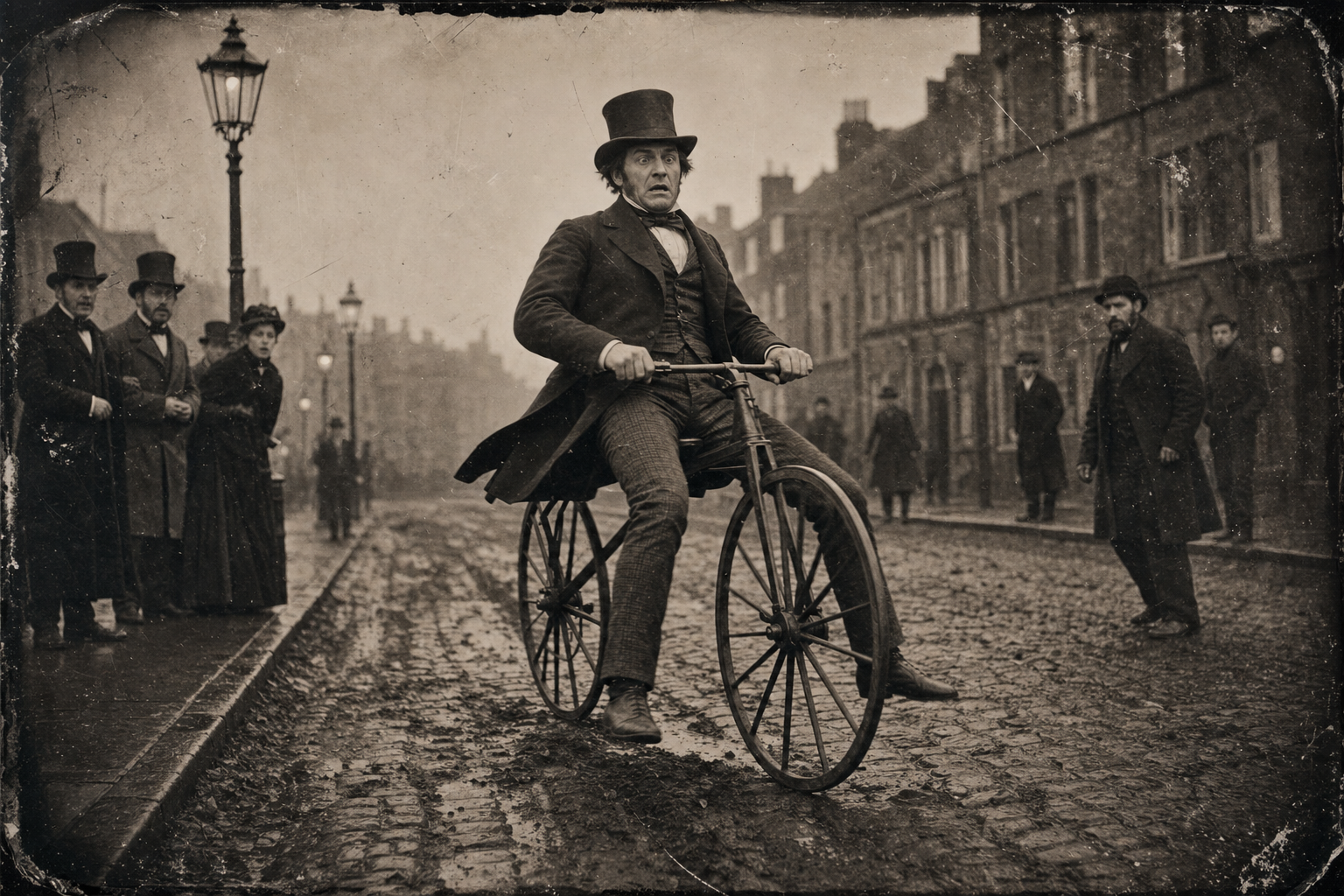
The 1868 velocipede craze lasted one season, caused a hospital hernia epidemic, and ended when riders discovered Victorian roads were nothing like a velodrome.
Welcome to Great Cycling Flops — our weekly series celebrating the most spectacular failures, baffling inventions, and heroic disasters in the history of cycling. Every Friday we dig into one episode from the archive. This week: the invention that launched a global craze, caused a hospital hernia epidemic, and was over in a single season.
The Year Everyone Decided the Bicycle Was the Future
In late 1868, something extraordinary happened in Europe and North America: an entire continent collectively decided that the bicycle had arrived. Not a modest uptake. Not cautious early adoption. A full-blown, headlines-everywhere, Harvard-students-are-obsessed, carriage-makers-have-abandoned-their-workshops craze. The velocipede — soon to earn its more descriptive nickname, the boneshaker — was going to change everything.
Riding schools opened in major American cities. Entrepreneurs converted warehouses into indoor velodromes where city dwellers paid to experience this miracle of modern transport. The New York Times covered velocipede demonstrations as social events. Carpenters, wheelwrights, and blacksmiths across France, Britain, and the eastern United States retooled their entire operations to manufacture the things. By early 1869, the craze had reached such a pitch that commentators were seriously predicting the death of the horse-drawn carriage.
By summer of 1869, it was over. Completely, utterly, and somewhat medically over.
What the Boneshaker Actually Was
The velocipede was the world's first mass-produced pedal bicycle — a genuine innovation built on the earlier German draisine (a balance bike without pedals). The key improvement was adding pedals directly to the front wheel hub, so the rider could actually propel themselves rather than scooting along with their feet. This was legitimately revolutionary. Pierre Michaux and his son Ernest in Paris are most often credited with the practical commercial version, though the precise history is contested.
The frame was wrought iron. The wheels were wooden, banded with iron. The saddle was a thin leather pad over a metal spring, mounted directly to the frame. There was no chain — the pedals attached straight to the axle of the front wheel — and there was certainly no suspension of any kind whatsoever.
This last detail is worth dwelling on. No suspension of any kind whatsoever. Every vibration transmitted by every irregularity in the road surface travelled directly, without interruption, through the iron wheels, the iron frame, and into the rider's body at full force. On a smooth wooden velodrome floor, this was merely uncomfortable. On the actual roads of 1868 — unpaved, ungraded dirt and cobblestone tracks churned by hooves and wagon wheels — it was something rather different.
The Streets of 1868 Were Not a Velodrome
Here is the central, beautiful irony of the boneshaker craze: it began as an indoor activity. The early velocipede demonstrations and riding schools operated in purpose-built halls on smooth wooden floors. The experience of riding one in this controlled environment was genuinely enjoyable — novel, fast, elegant. People paid good money to try it, went home delighted, told their friends, and created enormous demand for a machine that had been tested almost exclusively in conditions that bore no resemblance to where it would actually be used.
When the spring of 1869 arrived and riders took their boneshakers outside, several things became immediately apparent:
- Victorian road surfaces were composed of compacted dirt, loose gravel, mud, cobblestones, and horse-related materials, often in combination. Iron wheels with no suspension treated all of these identically: as a direct conduit for vibration into the human skeleton.
- The front-wheel drive system made steering on loose surfaces alarming. The pedals were part of the steering axle, so every pedal stroke affected the direction of travel.
- Hills were a significant problem. There was no gearing. Going uphill meant standing on the pedals and hauling with every muscle available. Going downhill meant the pedals spun at whatever speed the wheel dictated — potentially very fast, attached to the rider's feet, with no real braking capability.
- Other people were using the roads and footpaths, and they strongly objected to being mowed down by iron-tyred contraptions piloted by enthusiastic and not-always-competent new cyclists.
The Medical Situation
Cities across Europe and North America banned velocipedes from footpaths — in some cases, from roads entirely — within months of them appearing in numbers. This was partly a pedestrian safety measure, but the medical consequences for the riders themselves were perhaps more striking.
A bulletin from a London hospital, widely circulated in the cycling press of the era, recorded: "An alarming number of Hernia cases have, within the last two months, offered themselves at the Hospitals of the Metropolis." The combination of the extreme vibration, the physical effort of hauling an iron bicycle over rough surfaces, and the jerking, unstable riding position was, it turned out, doing real anatomical damage to riders. The boneshaker wasn't just uncomfortable. It was, under road conditions, actively injurious.
The Smithsonian Institution, in its account of the era, describes the velocipede craze as beginning and ending within a single riding season — which makes it one of the fastest rises and falls of any consumer product in industrial history. By the autumn of 1869, warehouses full of unsold boneshakers were being quietly repurposed, riding schools had closed, and the carriage makers who had pivoted their entire workshops were pivoting back.
What Came Next — and Why the Boneshaker Actually Mattered
The boneshaker's failure was not the failure of the bicycle. It was the failure of a specific, under-engineered implementation of a genuinely correct idea. The craze's collapse forced engineers to confront the actual problem: how do you give a bicycle rider isolation from road surfaces that are nothing like a velodrome?
The first answer was counterintuitive: make the front wheel enormous. If the wheel is big enough, small bumps become relatively negligible. This produced the penny-farthing — with its five-foot front wheel — which dominated cycling for the next twenty years while engineers worked on the real solution. That solution arrived in 1885 with the chain-driven safety bicycle (the direct ancestor of every bike sold today), and in 1888 with John Dunlop's pneumatic tyre, which provided actual suspension for the first time. By 1893, the boneshaker and the penny-farthing were both obsolete.
The boneshaker's legacy, though, is real. The global craze of 1868–69, however briefly it burned, established that there was an enormous popular appetite for personal cycling as transport and leisure. Every manufacturer, engineer, and investor who saw the craze understood that if someone could solve the road problem, they would have a market of almost unlimited size waiting for them. That realisation drove the next twenty years of bicycle development at extraordinary pace.
The boneshaker failed. The bicycle won.
Next Week in Great Cycling Flops
We move from a bike that was too rough to ride to a bike that was so tall it regularly killed its riders — and was mainstream transport for two decades anyway. The penny-farthing: why it existed, what it felt like to go over the front at full speed, and how it finally met its end.
And if you'd like a bike built with rather more attention to the road surface situation — come into Blue Cycles in Coconut Grove (open 7 days), call 08 8985 3921, or browse online at bluecyclesonline.com.au. We stock bikes with suspension, pneumatic tyres, and a complete absence of wrought iron.
Comments
Be the first to comment...