
Great Cycling Flops: Bike Inventions That Totally Failed
- Posted on
- By Blue Cycles Team
- 0
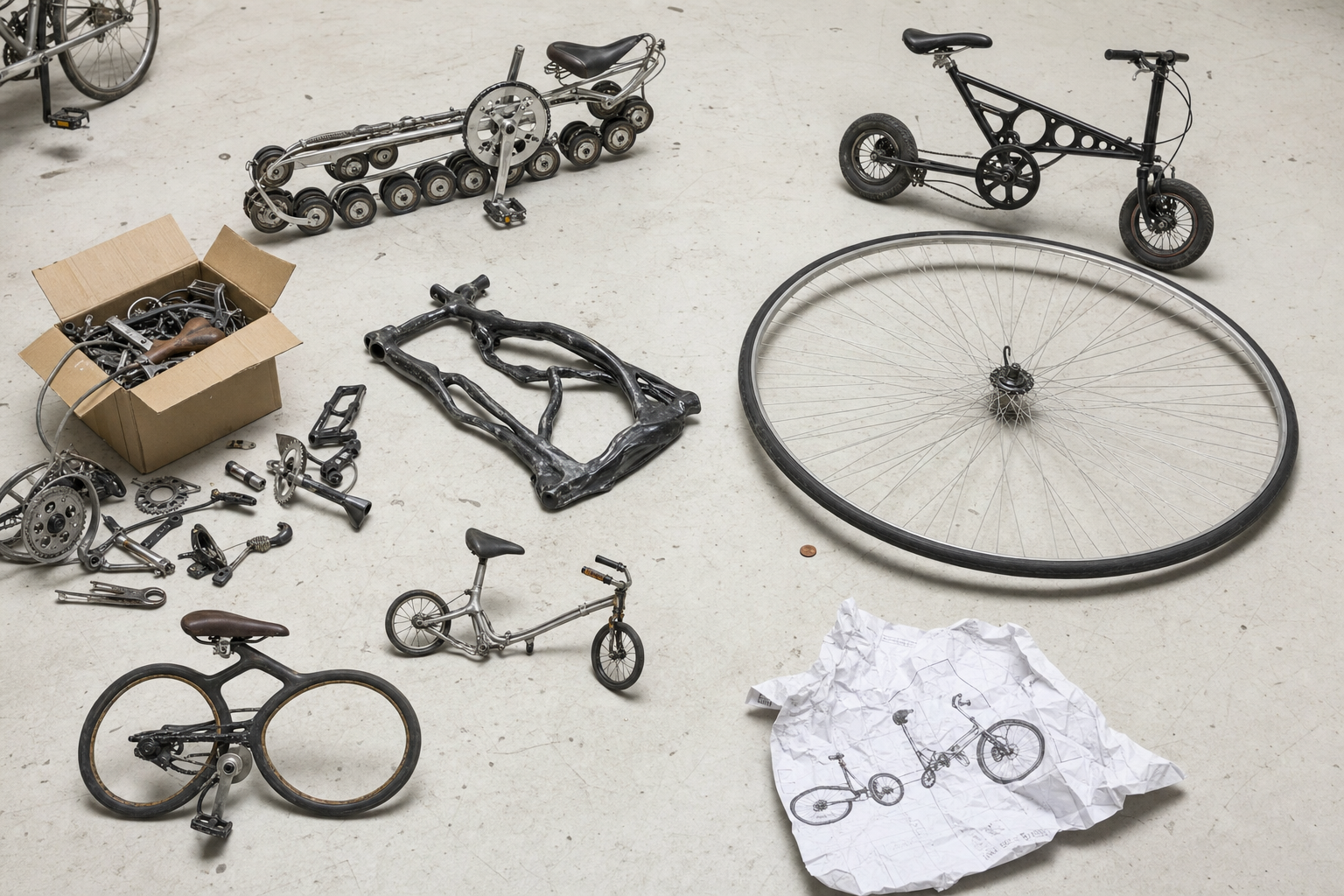
From a bicycle craze that caused a hernia epidemic to a hubless e-bike held together with tape — the funniest, weirdest failed inventions in cycling history.
We spend most of our time at Blue Cycles helping you find the right bike, keeping your current one running, and staying across what's actually worth buying in 2026. But every Friday we're doing something a bit different. Great Cycling Flops is our new weekly series — and it has absolutely nothing to do with what's on our shelves. It's pure cycling history, and specifically the part of cycling history nobody puts in the brochures: the spectacular disasters, the baffling inventions, and the ideas that were absolutely certain to change everything and instead changed precisely nothing. We're going all the way back to the very beginning of the bicycle, and working our way forward through 150 years of magnificent failures. New episode every Friday.
Cycling has given us the derailleur, the pneumatic tyre, carbon fibre frames, and electronic groupsets. It has also given us a bicycle that killed its inventor at full speed in front of an audience, a hubless e-bike held together with tape, and a plastic bike whose box arrived missing half the parts. The history of cycling is glorious precisely because for every brilliant invention, there are five spectacular disasters that promised to change everything and delivered something far more entertaining. Here's what's in the archive so far.
The Boneshaker Craze: One Season of Hernia (1868–1869)
Let's start at the beginning. The velocipede — later nicknamed the "boneshaker" — was the world's first mass-produced pedal bicycle, and it became an absolute sensation in 1868. Riding schools opened across American cities. Harvard and Yale students were fanatics. Carriage makers abandoned their entire workshops to manufacture them. By all accounts, the bicycle was here to stay.
It lasted one season. The boneshaker had an iron frame, iron-banded wooden wheels, and absolutely zero suspension. Riding one on cobblestones was less "transportation" and more "an extended session of involuntary vibration therapy" — hence the name. Cities banned them from footpaths after pedestrians complained about being mowed down. A London hospital bulletin reported "an alarming number of Hernia cases" among riders. The final insult: the craze had begun as an indoor, velodrome-based activity, and nobody had thought to check whether Victorian roads were anything like a velodrome before rolling these contraptions outside. They were not.
The Penny Farthing: A Death Machine That Was Also Mainstream
Before gearing was invented, the only way to go faster on a bicycle was to make the front wheel bigger. So engineers made the front wheel enormous — five feet in diameter was perfectly normal. The penny-farthing dominated cycling for nearly two decades in the 1870s and 80s, which is remarkable when you consider that the rider sat directly above the front axle at head height, with no meaningful braking capability, on a machine that was completely unrideable in rain.
Hitting any road debris caused the bike to stop instantly and the rider to "take a header" — cycling's polite term for being launched face-first over the handlebars from a height of roughly five feet onto unpaved Victorian roads. This happened so frequently it had its own dedicated name and its own dedicated injuries. Getting on required a running mount. Getting off meant slowing to a halt and jumping, or just falling. When pneumatic tyres arrived in 1888 and comfortable small-wheel bikes became possible, the penny-farthing became obsolete almost overnight. It had a twenty-year run as mainstream transport. The modern cycling helmet exists in part because of what that era taught us.
Death at Full Speed: The Roper Steam Velocipede (1896)
Sylvester Roper of New Hampshire built his first steam-powered velocipede in 1867 — essentially inventing the motorcycle before anyone else. He also invented the twist-grip throttle, controlled by a cord around his thumb. On June 1, 1896, Roper, now 73 years old, took his latest steam velocipede to the Charles River Speedway in Cambridge to demonstrate it as a cycle-pacer for bicycle racers. He lapped the track repeatedly, recording a mile in 2 minutes and 1.4 seconds.
Then, apparently delighted with himself, he went for an encore. The Boston Globe reported that spectators noticed the bicycle becoming "unsteady" on the back stretch. The throttle cord fell slack. Roper had died of a massive heart attack at full speed, mid-lap, on his own steam-powered invention, in front of an audience. He was described as motorcycling's "first martyr." He died doing what he loved — inventing, demonstrating, and going as fast as possible — and he took the throttle cord with him.
The UCI vs. The Lying-Down Bloke (1933–1934)
On July 7, 1933, a "mediocre second-category" club racer named Francis Faure arrived at the Vélodrome d'Hiver in Paris on a recumbent bicycle designed by Charles Mochet. The other racers reportedly jeered. "Stand up and pedal like a man." "Lying down will make you sleepy." Then Faure covered 45.055 kilometres in one hour, smashing the world Hour Record by a significant margin. The laughter stopped.
The record was legal under every existing rule. It was simply too fast. Within months, major bicycle manufacturers lobbied the UCI to strike the record. In April 1934, by a vote of 58 to 46, the UCI published a new "definition of a bicycle" — numbers that, by astonishing coincidence, perfectly excluded recumbents. Faure's record was quietly reclassified as a "special record." Here is the punchline: a conventional upright bicycle didn't beat Faure's mark until 1984 — 46 years later. The world speed record for human-powered vehicles, set by a fully faired recumbent, now stands at 144 km/h.
Britain's Finest Hour: The Sinclair C5 (1985)
Sir Clive Sinclair — the computing genius behind the ZX Spectrum — launched the C5 electric recumbent tricycle on January 10, 1985, with a £3 million advertising campaign proclaiming it "the future of personal city transport." The launch venue was Alexandra Palace in January. It was icy. Demonstration units broke down in front of assembled journalists. The Sunday Times called it "a Formula One bath-chair." The Guardian's reporter had a flat battery after seven minutes. Even Stirling Moss — brought in for positive publicity — ran out of battery on a hill and was photographed visibly sweating in the cold.
Real-world range was 6.5 miles, not the promised 20. The 250-watt motor overheated on gentle hills and emitted a warning beep before cutting out entirely. The vehicle sat so low that riders breathed exhaust fumes directly from passing trucks. Of 14,000 C5s built, only 5,000 were sold. Sinclair Vehicles went into receivership nine months after launch. The designer's verdict: he would never again be "satisfied to simply decorate a fundamentally bad idea."
The Crowdfunding Era: When $6.7 Million Bought 150 Bikes
Modern cycling history's greatest comedy genre is the crowdfunded bicycle disaster. The Reevo hubless e-bike raised $6.7 million on Indiegogo with sleek promotional videos showing fingerprint unlocking, integrated GPS, and futuristic spokeless wheels. Of the 2,700 people who ordered one, approximately 150 bikes were delivered before the company vanished, leaving their website as a GoDaddy parking page. Bikes that did arrive had the company name covered with a piece of tape — as though Beno Technologies already knew they were about to disappear and wanted a head start on anonymity.
Then there's the Superstrata — a 3D-printed carbon fibre bike that raised a record-breaking $7.17 million. The 3D-printed carbon wheels it promised were never produced. The premium components listed in the campaign were substituted for cheap alternatives with no refund. The SpeedX Unicorn raised $600,000 and delivered nothing after its sister company's abandoned bikeshare bikes went viral on Chinese news. The Cyclotron — a spokeless, internally-geared, hubless smart bike that raised $400,000 in 2016 — has, as one Reddit thread summarised in 2023, simply never arrived. "It also doesn't exist."
The Full Series — One Flop Every Friday
Each entry in this series gets its own full deep-dive, published every Friday. Here's where to find them — we'll add links as each one goes live:
- Week 1 — The Boneshaker: The Bike Craze That Lasted One Season (1868)
- Week 2 — The Penny Farthing: The Death Machine Everyone Rode Anyway (1870s–80s) coming soon
- Week 3 — The Roper Steam Velocipede: Death at Full Speed (1896) coming soon
- Week 4 — The UCI vs. The Lying-Down Bloke: How They Banned a Record for 46 Years (1933) coming soon
- Week 5 — The Sinclair C5: Britain's Most Humiliating Product Launch (1985) coming soon
- Week 6 — The Volvo Itera Plastic Bike: When a Car Company Tried Cycling (1981) coming soon
- Week 7 — Shimano Biopace: The Oval Chainring That Marketing Killed (1983) coming soon
- Week 8 — Graeme Obree & Old Faithful: Washing Machine Bearings, One World Championship, Two Bans (1993) coming soon
- Week 9 — The Softride Beam: Banned the Same Year the Company Quit (2007) coming soon
- Week 10 — SpeedX Leopard & Unicorn: The Smart Bike That Outsmarted Itself (2016) coming soon
- Week 11 — The Cyclotron: A Hubless Bike That Doesn't Exist (2016) coming soon
- Week 12 — The Reevo: $6.7M, 2,700 Orders, 150 Bikes, One Piece of Tape (2020) coming soon
- Week 13 — The Superstrata: 3D-Printed and Under-Delivered (2020) coming soon
In the meantime, if you'd like a bike that actually works — and has been properly serviced by someone who knows what they're doing — visit Blue Cycles in Coconut Grove (open 7 days), call 08 8985 3921, or book online at bluecyclesonline.com.au. No hubless wheels, no missing parts, no tape over the logo.
Comments
Be the first to comment...